
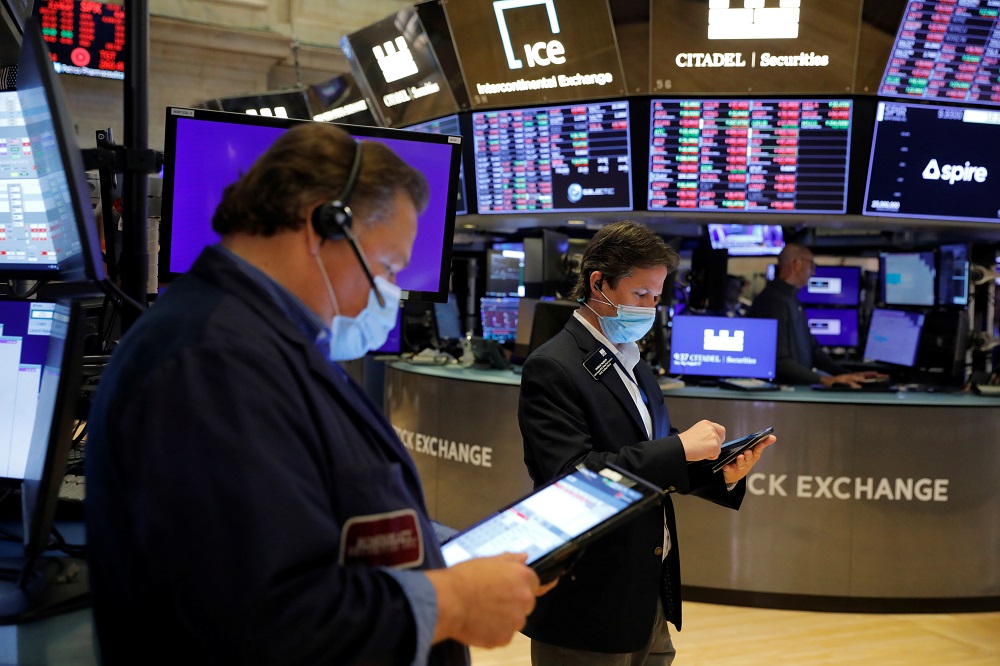
WASHINGTON, Nov 6 — World equities markets reached new heights yesterday after a session-long climb, booking a week of solid gains following a strong US jobs report.
The dollar index, which had hit a one-year peak earlier in the session, slightly retreated in late trading as risk appetite improved and stocks rallied.
The moves came after US Labour Department jobs data rebounded in a reassuring sign for investors who had worried for months about how stocks would fare once the Federal Reserve began rolling back the 2020 Covid-19 pandemic-fuelled stimulus.
Nonfarm payrolls increased by 531,000 jobs last month as the surge in Covid-19 infections over the summer subsided, offering more evidence that US economic activity was regaining momentum early in the fourth quarter.
Global stocks have seen a series of records in recent weeks, bolstered by blockbuster earnings reports from the biggest US listed companies.
The dollar index, which measures the greenback against a basket of six rivals, rose as high as 94.634 after the jobs report, its highest level since September 25, 2020. The currency’s strengthening to its highest level in more than a year offers the Fed more evidence that the economic recovery has regained momentum.
“If these numbers continue at this pace, we could probably see full employment at the end of the first quarter,” said Peter Cardillo, chief market economist at Spartan Securities.
Crude prices rose more than 2 per cent yesterday on renewed supply concerns after Opec+ producers rebuffed a US call to accelerate output increases even as demand nears pre-pandemic levels.
Brent crude was up US$2.14 (RM8.90), or 2.7 per cent, at US$82.68 per barrel. West Texas Intermediate crude (WTI) gained US$2.47, or 3 per cent to US$81.28.
“Markets know that the release of strategic reserves can only have a temporary bearish effect on prompt prices and is not a lasting solution for an imbalance between supply and demand,” Rystad Energy head of oil markets Bjornar Tonhaugen said in a note.
The Dow Jones Industrial Average rose 0.56 per cent, while the S&P 500 gained 0.37 per cent. The Nasdaq Composite added 0.2 per cent. The pan-European STOXX 600 index rose 0.05 per cent.
MSCI’s gauge of stocks across the globe gained 0.17 per cent.
Yesterday’s advances came even after the Federal Reserve announced on Wednesday that it would begin tapering its massive asset purchase programme, though Fed Chair Jerome Powell said he was in no rush to hike borrowing costs.
“Even though it transpired as expected, it is a significant milestone. The direction of travel is now clearly towards policy normalisation, though the Fed emphasised that tapering is not tightening,” said Stefan Hofer, chief investment strategist for LGT in Asia Pacific. “It was really expert communication and very well handled.”
US Treasury yields tumbled and the curve flattened in choppy trading yesterday amid uncertainty
The benchmark 10-year yield, which fell to its lowest level since September 24 at 1.436 per cent and marked its biggest downward move since July 19, was last 7.4 basis points lower at 1.4496 per cent.
In Asia, MSCI’s broadest index of Asia-Pacific shares outside Japan was 0.29 per cent lower, while Japan’s Nikkei lost 0.61 per cent.
Hong Kong had weighed on the regional index, falling 1.25 per cent as index heavyweight and rate-sensitive HSBC fell 3.6 per cent following a dovish call from the Bank of England (BoE) and anxiety over property stocks.
Trading in shares of Chinese developer Kaisa Group Holdings Ltd was suspended a day after the company said a subsidiary had missed a payment on a wealth-management product, the latest sign of a deepening liquidity crisis in the Chinese property sector.
An index tracking Hong Kong-listed mainland Chinese developers slipped 2.8 per cent, and an onshore China property index lost 2 per cent.
More broadly, Shanghai shares lost 1 per cent and Chinese blue chips slipped 0.5 per cent.
While investors were happy with the Fed’s communications, some felt that they had been misdirected by policymakers at the BoE.
The Bank of England’s decision on Thursday not to lift rock-bottom benchmark rates proved the biggest shock for markets and pushed sterling to its biggest one-day fall in more than 18 months by as much as 1.6 per cent on the day.
Sterling fell as much as 0.5 per cent yesterday, hitting a fresh one-month low of US$1.34250. It was last down 0.07 per cent.
Germany’s 10-year bond yield looked set for its biggest weekly drop since June last year, down 15 basis points as central banks left policy rates unchanged.
Spot gold added 1.4 per cent to US$1,816.73 an ounce. — Reuters
Global stocks, US dollar end lifted after labour pickup, oil gains
Source: Justice For Filipino


0 Mga Komento